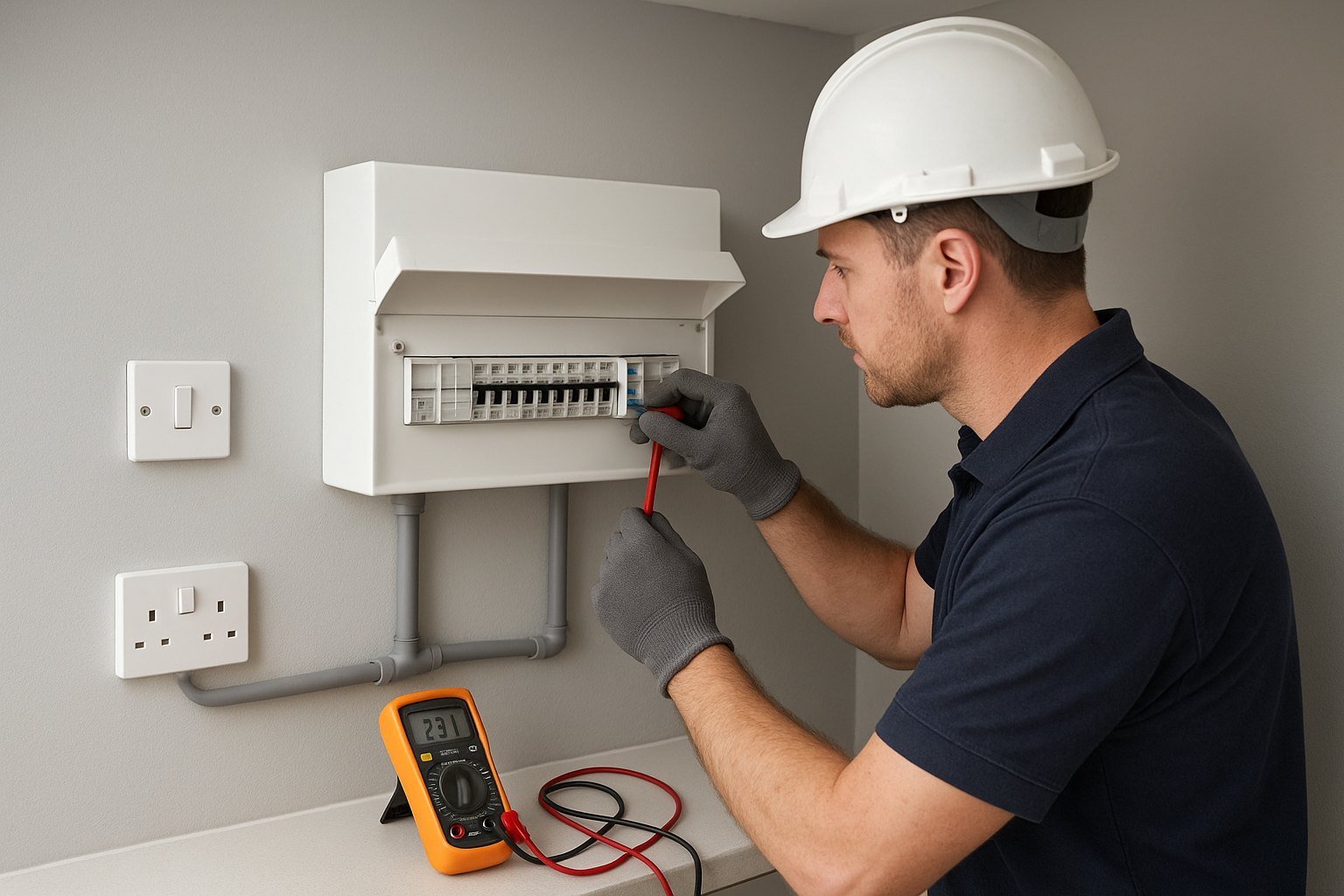
If your fuse box keeps tripping, a breaker will not reset, or you have a buzzing or hot fuse board, the safest next step is to have the fault inspected properly. Knight Wire Electricians provide fuse box repair in Teddington for homeowners, landlords, tenants and property managers, with clear advice on whether the issue is a straightforward repair, a breaker replacement, a consumer unit upgrade, or a full rewire.
We work across Teddington and nearby areas including Twickenham, Hampton Wick, Kingston, Hampton Hill and Richmond, with local jobs around Broad Street, Teddington High Street, Teddington Station, Bushy Park and Teddington Lock. That local mix matters, because the likely cause of a fuse board problem often depends on the age and type of property: Victorian terraces, converted flats, older rewires, modern flats, shops and offices can all present very different symptoms.
Our approach is simple: find the cause, explain the options in plain language, and help you choose the safest practical fix. If the issue is limited to one circuit, a targeted repair may be enough. If the consumer unit is outdated, damaged or showing repeated faults, an upgrade may be the better decision. If the wiring itself is deteriorating, a rewire may be the right long-term answer. Call 020 3519 9561 or email info@teddington-electricians.co.uk to arrange a visit.
We are based at 65 Broad St, Teddington TW11 8QZ, United Kingdom and operate 24 hours for electrical support. For safety, if you notice burning smells, heat from the fuse board, signs of arcing, or repeated breaker trips, switch off affected circuits if you can do so safely, keep clear of the board, and arrange an electrician promptly.
Fuse Box Fault Finding in Teddington
Fuse box fault finding is the starting point when the problem is not immediately obvious. In many Teddington homes, especially older properties and converted flats, the symptom is not a complete loss of power but a pattern: one circuit trips after a kettle is used, the lights flicker when an appliance starts, or the consumer unit becomes noisy under load. In shops and offices near Teddington High Street or Broad Street, the issue may show up as intermittent loss of sockets, lighting circuits that fail at busy times, or a board that has become difficult to reset.
Fault finding usually begins with a visual inspection of the consumer unit, breakers, cabling terminations and any obvious signs of overheating, damage or moisture. From there, the likely fault is narrowed down by isolating circuits, checking the pattern of trips and testing the equipment connected to the affected circuit. The goal is not to guess; it is to identify whether the problem sits in the fuse board itself, in a socket or light fitting, or deeper in the wiring.
Common symptoms that point to fuse box fault finding include:
- The fuse box keeps tripping without a clear cause.
- Breaker will not reset after a trip.
- Half the house has no power.
- Lights or sockets fail in one part of the property only.
- There is buzzing, heat, or a burning smell at the board.
- Trips happen when an appliance such as a washing machine, heater or kettle is used.
Likely causes can include a faulty appliance, overload on a circuit, a damaged breaker, loose connections, water ingress, deteriorated cable insulation or a board that is simply past its best. In older Teddington properties, especially those with older rewires or legacy fuse wire boards, the issue may be a combination of age and wear rather than a single failed part.
We recently carried out a fuse box advice visit in Kingston where circuits were tripping and the customer needed a clear explanation of consumer unit repair or upgrade options. That kind of visit is often the most useful first step: identify the fault, isolate the risk, and then decide whether repair, upgrade or further investigation is the right route.
If the fault is affecting safety, the equipment may need to be isolated until the problem is resolved. Some consumer unit work can be notifiable under Part P of the Building Regulations, so it is important that any repairs or upgrades are handled by a competent electrician who can advise on certification where required.
Tripping Breaker Investigation in Teddington
A tripping breaker investigation is needed when a breaker repeatedly switches off, especially if it trips as soon as you reset it or trips under normal use. This is a common call-out in Teddington flats, maisonettes and family homes where several high-demand appliances share the same circuit. It is also common in properties near Bushy Park and Teddington Station where older wiring has been adapted over time and the electrical load has increased.
The key decision point is whether the breaker is doing its job by protecting a genuine fault, or whether the breaker itself has become unreliable. A breaker that trips because of overload, a short circuit or earth fault is often protecting the property from something more serious. A breaker that will not reset may be pointing to a fault on the circuit, a failed appliance, or a damaged device in the consumer unit.
During an investigation, we check the circuit behaviour, isolate connected equipment and inspect the consumer unit and associated wiring. In practical terms, that means looking for the real source of the trip rather than replacing parts at random. Where a single socket, light fitting or appliance is causing the breaker to trip, the repair can be targeted. Where the circuit is overloaded or the breaker is no longer operating correctly, the solution may involve a breaker replacement or a wider upgrade.
Decision points often include:
- Is the problem limited to one circuit or affecting multiple circuits?
- Is the breaker tripping because of an appliance or because of the wiring?
- Is the consumer unit modern enough to support the property’s current load?
- Has the issue become more frequent after new appliances or alterations?
For landlords and property managers, a tripping breaker investigation is especially important where tenants report repeated loss of power. A quick reset may restore supply temporarily, but repeated trips should be treated as a fault to investigate, not an inconvenience to ignore.
We recently checked a tripping circuit in Hampton Hill, isolated the affected circuit and gave clear repair advice after inspecting the consumer unit. That is often the most useful outcome for the customer: a safe temporary position, a clear explanation, and a proper plan for repair or replacement.
RCD Nuisance Tripping in Teddington
RCD nuisance tripping in Teddington is often reported when a property loses power unexpectedly and the RCD or RCBO trips even though nothing obvious seems wrong. Many customers assume the device is “too sensitive”, but in electrical terms there is usually a reason. The device may be detecting leakage current from an appliance, moisture in a fitting, damaged cable insulation, or cumulative leakage from multiple items on the same installation.
This issue is common in older homes and converted flats where circuits have been added or altered over time, and in properties near Teddington High Street or Richmond where kitchens, utility rooms and bathrooms have a higher chance of moisture-related faults. It can also happen in modern flats if several appliances, such as dishwashers, washing machines, chargers and heating controls, are all contributing to the same circuit behaviour.
RCD nuisance tripping can feel random, but the investigation usually reveals a pattern. We look at when the trip happens, what was running at the time, whether it occurs in damp weather, and whether the fault follows a specific appliance or circuit. A careful test process helps separate a genuine electrical fault from a normal protective trip.
Possible causes include:
- A faulty appliance or accessory on the circuit.
- Moisture entering an external fitting or garden supply.
- Ageing insulation on older wiring.
- Loose connections or damaged terminations.
- Multiple small leakage currents adding up across the installation.
Repair versus upgrade is an important decision here. If the cause is one appliance or one damaged accessory, a repair may solve it. If the consumer unit is outdated, lacks suitable protection or is struggling with the existing installation, an upgrade may be the more sensible option. In some older Teddington properties, repeated nuisance tripping is a sign that the board and wiring no longer work well together.
Aftercare matters too. Once the fault is found and corrected, the installation should be tested again so the customer knows the circuit is stable under normal use. If the issue was caused by a specific appliance, the customer should keep it out of service until it has been checked or replaced.
Faulty Breaker Replacement in Teddington
Faulty breaker replacement in Teddington is appropriate when testing suggests the breaker itself is no longer operating correctly. Breakers are safety devices, and when one becomes worn, overheated or unreliable, it can cause unnecessary trips or fail to protect the circuit as intended. This is not something to leave in place if the device is showing signs of damage or repeated failure.
Signs that a breaker may be faulty include a breaker that trips with no obvious load issue, one that feels loose or inconsistent when reset, visible heat damage, or a breaker that behaves differently from the others in the consumer unit. In some cases, the breaker is not the original cause but has been stressed by a problem elsewhere. That is why replacement should follow proper fault finding rather than guesswork.
We assess whether the breaker can be replaced safely and whether the rest of the board is in suitable condition. If the consumer unit is old, crowded, heat-damaged or lacking modern protection, replacing one breaker may only be a short-term fix. If the board is otherwise sound and the issue is isolated, a targeted replacement can restore safe operation without unnecessary work.
In Teddington, this comes up in a range of properties: older terraces with upgraded kitchens, converted flats with mixed-age wiring, and commercial spaces where the electrical load has changed over time. The right answer depends on the condition of the board, the circuit, and the equipment connected to it.
We also look at related issues such as socket damage, lighting faults and cable condition because a breaker can only do its job properly if the rest of the circuit is in good order. If the same breaker keeps failing after replacement, there is usually a deeper fault that needs further investigation.
When replacement is the right option, we explain the practical effect: what has been changed, what has been tested, and what the customer should watch for afterwards. That aftercare helps prevent repeat call-outs and gives landlords and property managers a clearer record of the work completed.
Fuse Board Safety Checks in Teddington
Fuse board safety checks in Teddington are sensible whenever there are warning signs, recent electrical changes, or uncertainty about the age and condition of the consumer unit. A safety check is especially useful in older homes, older rewires, and properties where the fuse board has not been reviewed for some time. It is also a sensible step for landlords, tenants and property managers who need to understand whether a reported fault is isolated or part of a wider risk.
A proper safety check looks beyond the obvious trip. It considers the condition of the board, the breakers, the cabling terminations, the circuit arrangement and whether the installation appears to match the way the property is now used. In a Victorian terrace or converted flat, for example, the electrical load may have increased significantly since the original wiring was installed. In a shop or office, added equipment can place more demand on circuits than they were designed for.
Safety checks are useful when you notice:
- A buzzing or hot fuse board.
- Frequent tripping after recent appliance changes.
- Old fuse wire boards or outdated consumer units.
- Signs of wear around the board or nearby cabling.
- Unexplained loss of power in part of the property.
Depending on what we find, the next step may be repair, upgrade or rewire. A repair is often suitable when the problem is localised and the rest of the installation is sound. An upgrade may be the better option when the consumer unit is outdated or no longer suitable for the property’s current electrical demands. A rewire becomes more likely when the wiring itself is deteriorating, poorly adapted, or repeatedly causing faults across multiple circuits.
After the check, we explain the result in plain English and outline the decision points clearly. That means you know whether the issue is urgent, whether the property can remain in use, and what work should be planned next. For many customers in Teddington and nearby areas, that clarity is the real value: it turns an electrical fault from a stressful unknown into a manageable repair plan.
If you need fuse box repair in Teddington, Knight Wire Electricians can help with fault finding, tripping breaker investigation, RCD nuisance tripping, faulty breaker replacement and fuse board safety checks. Call 020 3519 9561 today or email info@teddington-electricians.co.uk to request a visit. We support domestic and commercial customers across Teddington, Twickenham, Hampton Wick, Kingston, Hampton Hill and Richmond.